On the

Still Drumming After 75 Years
Trinity Academy of Drumming Arts was founded by Elias Toscano - musician, producer, educator, inventor. Elias has been a drummer for 75 years and studied under many great teachers. He is fond of saying "you are standing on the shoulders of giants" and wants to share this legacy with other dedicated drummers.
Recorded live at Alvas's Showroom

Haverim
Haverim is a classic jazz trio - Wayne Peet on piano and keyboards, Roberto Miranda on upright bass, and Elias Toscano - drums, composer, and producer.
The Art & History of Drumming
Learning the history of drumming is essential for any drummer, as it provides context and appreciation for the art form. Understanding the evolution of rhythms and techniques across different cultures enriches a drummer's perspective and enhances their creativity.
Additionally, mastering fundamental techniques allows drummers to build a strong foundation, enabling them to explore more complex patterns and styles.
This combination of historical knowledge and technical skill ultimately leads to greater musical expression and versatility.


A Good Teacher is Essential
I learned from the best.
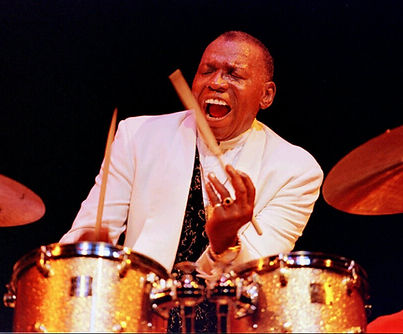
It's a little know fact that Elvin started out playing blues guitar. His favorite players were John Lee Hooker and Muddy Waters, and the Mississippi Delta-like players, very earthy... just like his drumming. Check out his guitar on Heavy Sounds with Richard Davis. Earthy Delta blues comes from the deepest of bittersweet human emotion, and hard earned wisdom. There is a saying: "Above all else, get wisdom!"
That feeling that Flamenco calls "Cante Hondo," Deep Song, and wisdom permeated Elvin Jones' drumming. It's who he was. Elvin was a learner. He believed in never stopping learning. Elvin was an unassuming, humble guy. Maybe even a little shy (except on the drums.) That undogmatic openness is the only way one learns and inspires creativity. His innovative drumming changed the way we drum. Probably for you, too. Go back and listen harder to him.
Drumming is thousands of years old. It is an unbroken chain expressing the deepest truth about being human. It is a deeply spiritual thing that AI will never achieve. This is the taproot that Elvin revealed when he played the drums. It was a major blessing in my life for which I am very grateful and hold in deep esteem.
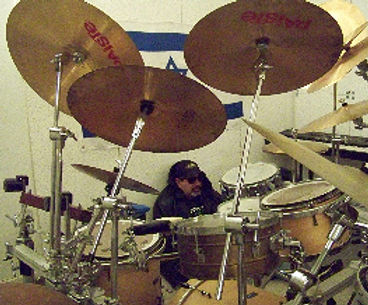
Still Drumming After 75 Years
The Evolution of My Drumming Over the Years... What's Yours?
-
Age 3 Classical piano - with my aunt.
-
Age 6 Began drum lessons with Master Sergeant William Hartman.
-
12 Years of school band - High School teaching assistant.
-
1960s Trinity University Classical Percussion with Harvey Biskin, Houston Symphony.
-
Mid 1960s Moved to LA. Staff percussionist with CBS. Active in LA jazz scene.
-
Met Elvin Jones at Pro Drum Shop. He borrowed my trio for his local gigs. I received intensive drum studies with him. Polyrhythmic drumming.
-
Later, I met Max Roach at Pro Drums. Did drum clinics with him. I was the student. Great lessons, melodic drumming, tune-smithing.
-
Worked off and on with legendary jazz pianist, Horace Tapscott.
-
Late 1960s Moved to New York. Looked up Ornette Coleman, friend of friend. I spent time at his house, learning about his harm0lodic music theory and the use of two drummers: Billy Higgins and Ed Blackwell. Ed "Boogie" Blackwell was a genius drummer from New Orleans. I played duets with Billy Higgins. Active in NY jazz scene. Played with alumni of Miles Davis in the NYC Jazzmobile.
-
1970 Brief interlude - University of Ohio. Artist and Composer-in-Residence. Taught Jazz History. Same year as Kent State shootings - students killed protesting Viet Nam War. Played concerts all over Ohio and neighboring states, including with the eccentric Sun Ra. Look him up.
-
Back to California, this time to San Francisco. Very active in Latin jazz scene - Santana heyday. Much studio work with alumni Santana, Sly Stone, Graham Central Station, Tower of Power. Led fusion-jazz trio -34 piece drum set with various players Bay area. Became interested in electronic music. Studied at San Francisco Conservatory with Serge Tcherepnin, including study of Russian music descended from Rimsky-Korsakov through the Tcherepnin family.
-
Highlight from San Francisco: first use of a synthesizer in a major jazz festival: 2nd Annual Berkeley Jazz Festival.
-
Performed multi-media performance art for Museum of Conceptual Art, NEA-sponsored concerts at annual Edinburgh Art Festival, and futher concerts in city of London at International Contemporary Art Gallery. Opportunities arose down South as San Francisco was waning.
-
Back to LA. Hired off the bandstand in the middle of a concert to teach Jazz Studies at the University of Southern California. Jazz gigs with local artists, studio work, hired as staff producer for Hollywood Records (Disney). Found myself producing "Gangsta Rap". Turned out to be real gangsters. Quit Disney and resigned from USC.
-
Moved to Orange County, California. Began graduate school in Judeo-Christian theology at Simon Greenleaf University and, on my own, studies in ancient modal church music, just like my favorite modal jazz.
-
Produced acoustic jazz trio, Haverim (see video.)
-
Co-composed and produced Judeo-Christian rock album, Shiloh's Cup "Wounded."(https://www.amazon.com/Wounded-Shilohs-Cup/dp/B002FG9INC/ref=sr_1_2?crid=9RQ002031WN1&dib=eyJ2IjoiMSJ9.g-i3-OHTWLWiH_ksrPKSyQ.Ut5XokYiZbW-68f92c4yVq1nckk4n-lS2hztgkzsoBM&dib_tag=se&keywords=Shiloh%27s+cup+CD&qid=1765060695&sprefix=shiloh%27s+cup+c%2Caps%2C218&sr=8-2)
-
Throughout my career, I have always maintained a teaching studio. I taught jazz drumming and percussion, wherever I was and with whomever was interested.
-
I am an inventor - drum tuning system and medical devices. I am an investor and investment advisor. It's all math, just like music, except musical math are the tools of a spiritual art. I divide everything into two categories: jazz and not-jazz;
jazz is a Ferrari, not-jazz is a Prius.
Inspired = In-Spirited is authentic jazz; overproduced not-jazz is mechanistic
-
There is a great diversity of inspired music around the world. As a musician, to ignore it is only to your detriment.
-
"History is very important to a jazz musician" - Louis "Satchmo" Armstrong. He conquered the world with a jazz trumpet. BTW, the number one best selling book in the world, the Bible, is full of all kinds of trumpets.
-
If I would advise you, I would only say - just be your only, unique self.
Elias "Eliyahu" The Drum Teacher.
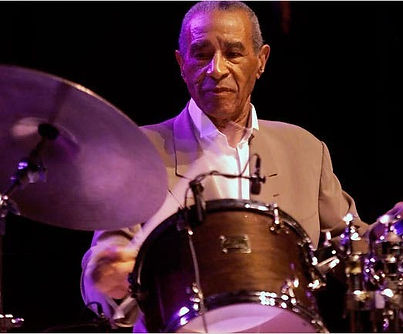
When I met Max Roach my main interest was jazz drumming and what I could learn from him. We did clinics together in Hollywoood. He was the master and I was the (well-rehearsed) student. As I got to know him, beyond what I could learn about jazz drumming, I understood that Max was very intellectual, and a kind of Renaissance man.
He is mostly identified with the birth of hard Bop, but was very committed to advancing civil rights for blacks, and for all people. He put that concern into his art, and never missed a chance to do it. He was a composer, with broad tastes and diverse ideas about music and civil rights. "Freedom Suite" was a musical statement as bold as Dr. Martin Luther King's. He wrote scores for Alvin Ailey, gifted choreographer and civil rights activist. The great playwright of Americana, Sam Shepard, understood that Max could write the American music that fit his plays best. Max developed an all-percussion group, M'Boom, that was multi-ethnic. He also put together a group of all brass and drums, harkening back to the brass bands of New Orleans. Max played with and composed gospel choirs and jazz-influenced classical string quartets, with his daughter, Maxine.
Not limiting himself, Max played the most avant garde jazz with Anthony Braxton, Archie Shepp, and the avant garde great - pianist Cecil Taylor. He also worked with video artists, rap and hiphop, and drumming-backed spoken word, such as Dr. Martin Luther King's "I Have a Dream." Countless awards... he lost count. I saw him play and do a concert/clinic with nothing but a Hi-Hat to great response and encores, standing ovation. All of the over-produced digitized enhanced AI music is always behind, trying to emulate and catch up with a single master, like Max Roach, who is a fountainhead. I do many things, like Max: art, business, inventions, politics, and Christian evangelism through music education. I know Max saw himself first as a jazz drummer. If you scratch me, you will find the same. Rat-a-tat-tat.
The Evolution of Drumming Roots
And the Evolution of the Drum Set

Dee Dee Chandler
Dee Dee Chandler played New Orleans 2nd Line Drumming with the earliest New Orleans jazz ensembles. Could be he played with Buddy Bolden, who inspired Louis Armstrong. BTW, Dee Dee invented the bass drum pedal.

Warren "Baby" Dodds
Warren "Baby" Dodds played very early jazz. Up from the river boats, to King Oliver's Creole band to Louis "Satchmo" Armstrong, one of the most influential drummers along the drummers' grapevine to this day.
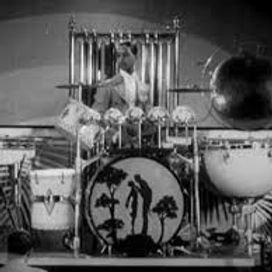
Sonny Greer
Big Bands! Sonny played with Duke Ellington. Ellington took advice on arrangements from Sonny. Nuff said.

Chick Webb
Chck had incredible technique, was a band leader, and great showman. Discovered a teenaged Ella Fitzgerald and built a band around her.

Papa Jo Jones
Papa Jo Jones with Count Basie - elegant taste and precision. I took a few lessons from him before I knew who he was (as did many others) at Frank Ippolito's drum shop in NYC just for the love of it.
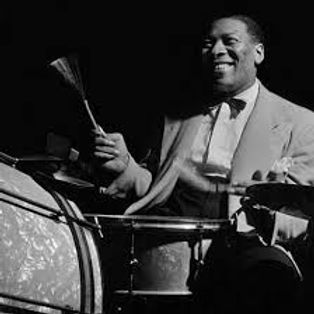
Big Sid Catlett
The bridge between Big Band and Bop. Epic technique but played a deceptively simple style. Max Roach told me Sid was his greatest influence.

Gene Krupa
Gene Krupa transformed drumming from a background role to a featured instrument, becoming a superstar during the Swing Era, playing with Benny Goodman. BTW, he invented the drum solo.
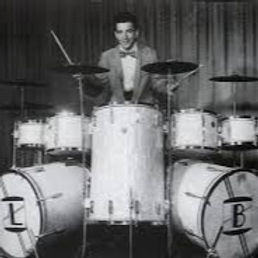
Louis Bellson
Big Band drummer, as good as it gets. Accomplished composer and arranger. Amazing drum sets! Artiste.
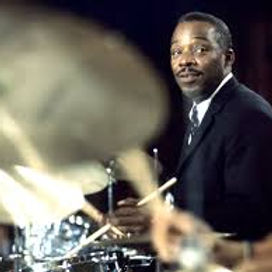
Kenny Clarke
Kenny Clarke made the jump from Big Band swing by making the jazz ride on the cymbal the timekeeper and not the bass drum. Completed the bridge to Bop. There would be no Max Roach without Kenny.
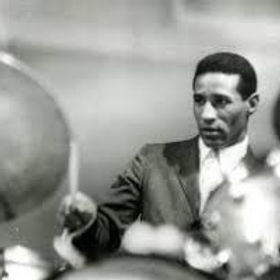
Max Roach
Max Roach invented melodic drumming. "Don't play the drums, play the tune." With Charlie Parker, created the gold standard for Bebop.
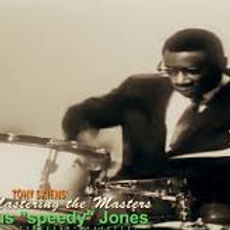
Rufus "Speedy" Jones
With the Ellington Orchestra, but also with Ellington's small ensembles, check out his press roll on YouTube. OMG.
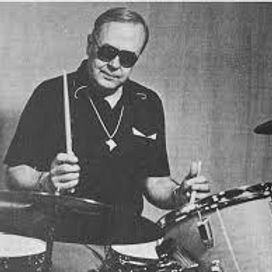
Joe Morello
Mr. Take Five with Dave Brubeck. Doesn't get any better. Faster with one hand than you are with two. LOL.

Art Blakey
Art Blakey led many great jazz bands and gave many players their start. His own drumming was hard swinging, thunderous Bebop. A very kind, generous man, he let me sit in with his band at Slugs' in the East Village on Monday nights.
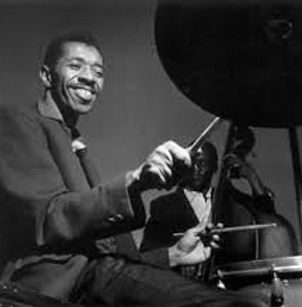
Philly Jo Jones
Philly Joe Jones was influenced by Max Roach, but then developed his own style. Miles Davis said Philly Joe Jones was his all-time favorite drummer. Period.

Jimmy Cobb
Another player's player. Listen to his work on Miles Davis’ “Kind of Blue.” Considered one of the most important jazz classics.

Elvin Jones
Elvin's polyrhythmic triplet subdivisions over the whole set changed drumming and drummers forever. You can hear his ideas in John Bonham's (Led Zepprlin) and Mitch Mitchell's (Jimi Hendrix) drumming, and probably yours, if you're lucky. His generous willingness to mentor me is the greatest gift my drumming could ever have received. Typical Elvin Jones lesson: "play some bleep sorta like this. Now play it as slow as a ballad. *laughs* Now do it again."

Tony Williams
The modal neo-bop of the Miles Davis Quintet with Ron Carter, bass, Herbie Hancock, piano, Wayne Shorter, tenor sax, and Tony on drums is an unsurpassed peak of acoustic jazz. Grounded in classic jazz drumming, he took his art to a whole other level and was instantly recognizable. One night in LA, Miles was playing in a local club with Tony on drums. The next day, the joke was "did you see the Tony Williams show?" Tag ending. Here begins use of electronic instruments and the birth of fusion.
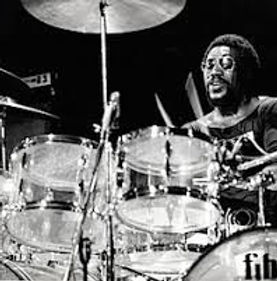
Billy Cobham
Legendary Panamanian-American jazz- fusion drummer, composer, and bandleader, He is often called fusion's greatest drummer. His work with the Mahavishnu Orchestra tunes and odd meters must be heard to be believed.
THE DRUM COACH
Reach Your Full Potential As A Drummer
and Develop Your Own Style
Limited offer for 2026
First answer a few questions;
-
What is your full name and age? Ages 12 to 21 or ages 18 to 40 only.
-
How long have you been playing?
-
As you grew up, what was the earliest kind of music you were exposed to?
-
What kind of music do you listen to and would like to play drums in?
-
Are you self-taught, or have you had any formal lessons by a professional drummer or educator (rudiments, reading drum notation, etc?) For example, none, little, moderate, skilled, 4-way time keeping, any other instrument, music theory, song form? Details please.
-
Describe your drum set, extras, snares, percussion, etc.
-
How much can you practice daily/weekly for the next year? Be realistic.